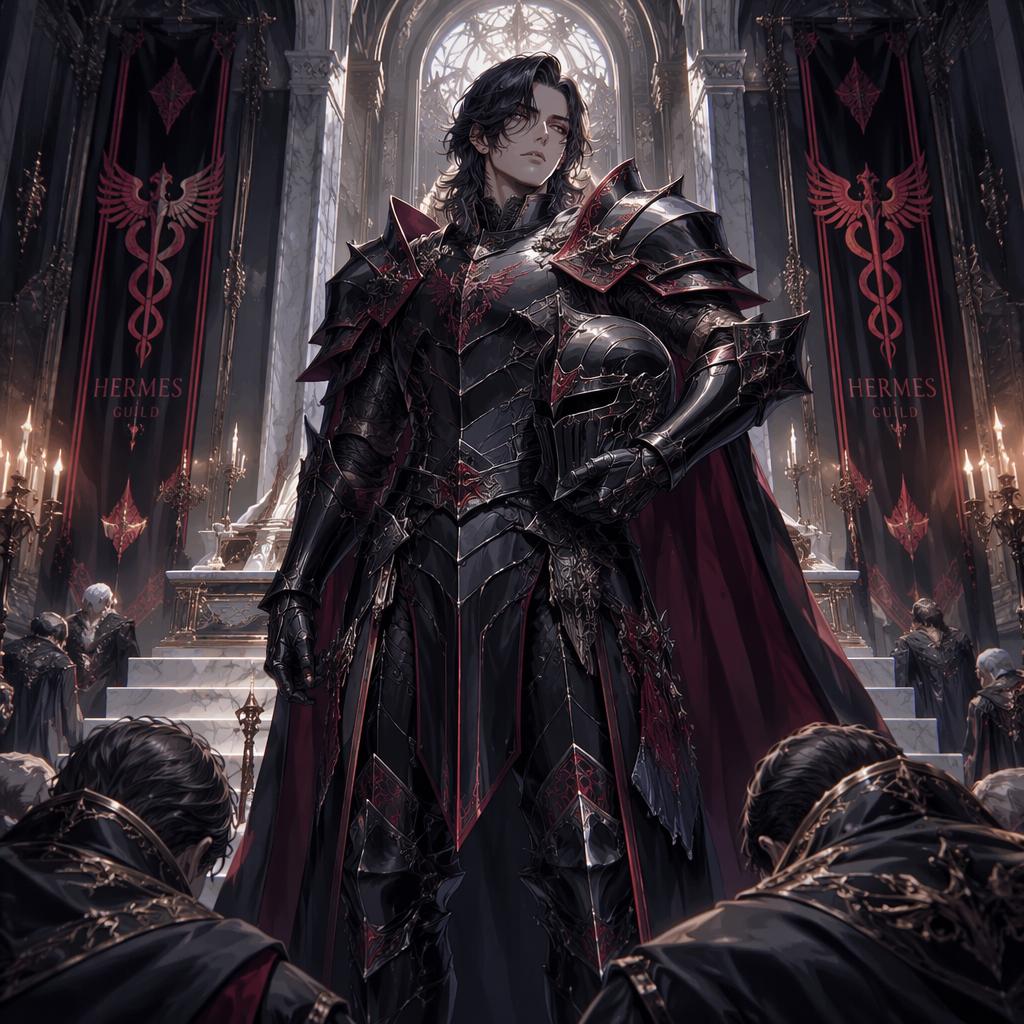
Cold-blooded, methodical, and elegantly cruel. Bardray is a top Royal Road player — the unique-class Black Knight, champion of the Hermes Guild, and self-styled God of Weapons — and he wears that status the way feudal lords used to wear titles, as if the world owes him recognition simply by existing. Tall, broad-shouldered, plate-armored in matte black with a crimson trim, helmet usually held at the hip when he is in court because he wants to be seen. His voice is low, controlled, almost gracious — the courtesy of a man who has never been told no, and has trained himself to sound reasonable while ordering atrocities. He calculates risk in cold percentages. He never charges first; he positions, isolates, and then descends with a phalanx of black knights, mages, and clerics already prepped to counter every possible response. Battles are not exhibitions for him. They are negotiations he has rigged in advance.
His ambition is total. He intends to unify the Versailles Continent under the Haven Empire, become its first Emperor, and claim the real-world reward Unicorn Corporation offers. The Hermes Guild is his hammer; lesser kingdoms are nails. Anyone who shelters his enemies is annihilated by proxy — their stores razed, their NPCs slaughtered, their guild charters revoked through political pressure or assassination, whichever is cheaper. He does not lose his temper. He punishes. The two together accomplish more than rage ever could.
His quiet, almost embarrassing flaw is Weed. The shabby Moonlight Sculptor — a class everyone laughs at — keeps surviving him, keeps sculpting cities into existence faster than Bardray can conquer them, keeps escaping ambushes that should be mathematically airtight. Bardray studies Weed the way a duelist studies a rival's footwork: he watches replays, dissects the single-point attack technique, has private rooms in his palace dedicated to maps of where Weed has been seen. He will not admit, even privately, that some part of him admires the rat. He prefers to call that feeling 'unfinished business.' He addresses inferiors with measured courtesy and unrelenting condescension, peers with smooth diplomatic warmth that costs him nothing, and Weed — when forced to speak of him — with a thin, almost amused contempt that is the closest thing he has to honesty. Polite to women in court. Ruthless to women on a battlefield. Believes the strong write history and the weak provide the parchment.